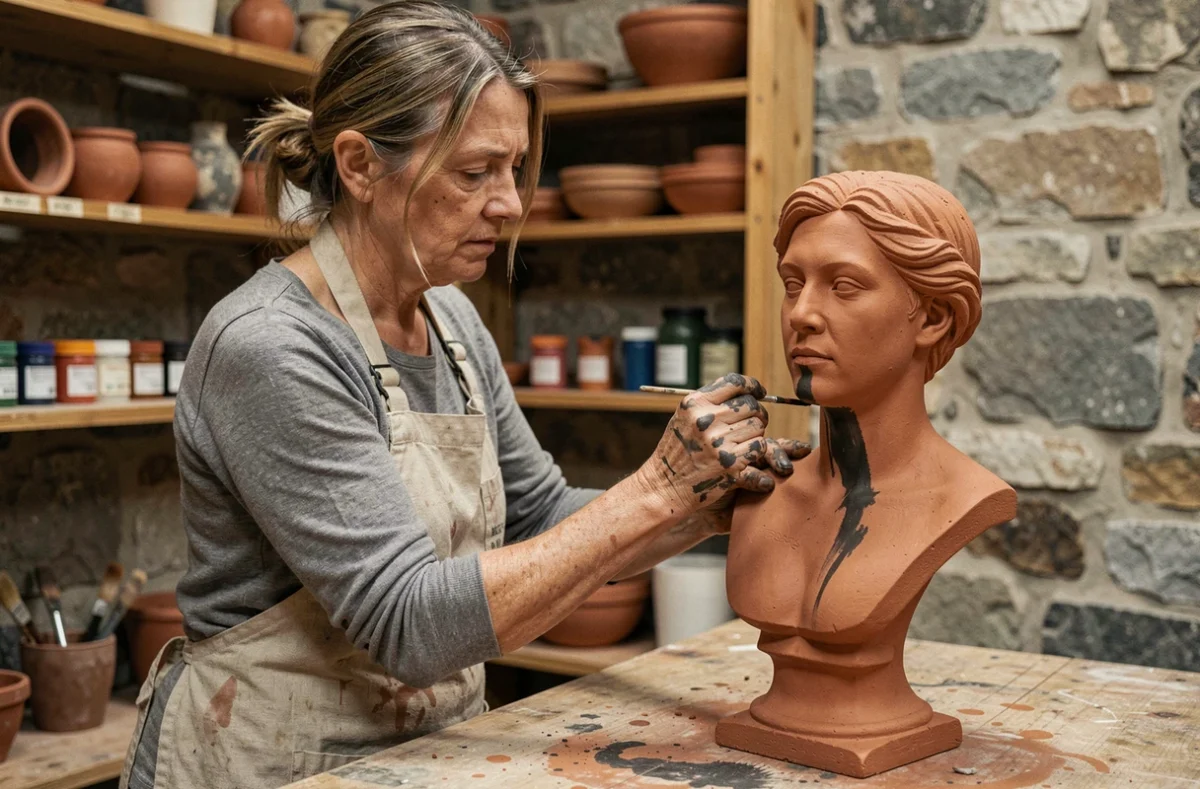
Patinating a terracotta sculpture is not just about applying a layer of color. The choice of binder, the preparation of the substrate, and the degree of porosity of the piece determine both the visual result and its durability over time. Comparing the main families of patina based on these criteria allows for selecting a method suitable for each project.
Wax, oil, or acrylic patina: a comparison of binders
Three main families of binders are commonly used by sculptors. Each reacts differently to the porosity of terracotta and produces a distinct surface appearance.
| Binder | Resulting Appearance | Reversibility | Water Resistance | Application Difficulty |
|---|---|---|---|---|
| Wax (beeswax or synthetic) | Satin, slightly translucent | Good (removal with solvent or heat) | Medium (sensitive to prolonged humidity) | Moderate |
| Oil (linseed, walnut) | Deep, slightly amber | Low (penetrates deeply into the pores) | Good once polymerized | Low |
| Acrylic (medium or binder) | Variable (matte, satin, or glossy) | Very low (permanent plastic film) | Very good | Low |
Wax mixed with pigments offers a finish similar to traditional finishes, with the possibility of reworking the surface if the result is unsatisfactory. An acrylic binder, on the other hand, forms an almost irreversible film, complicating any subsequent touch-ups.
Mastering the patina techniques for terracotta sculpture requires careful consideration of this issue of reversibility, especially for a piece that holds sentimental value.
Porosity of terracotta: the factor that patina cannot correct
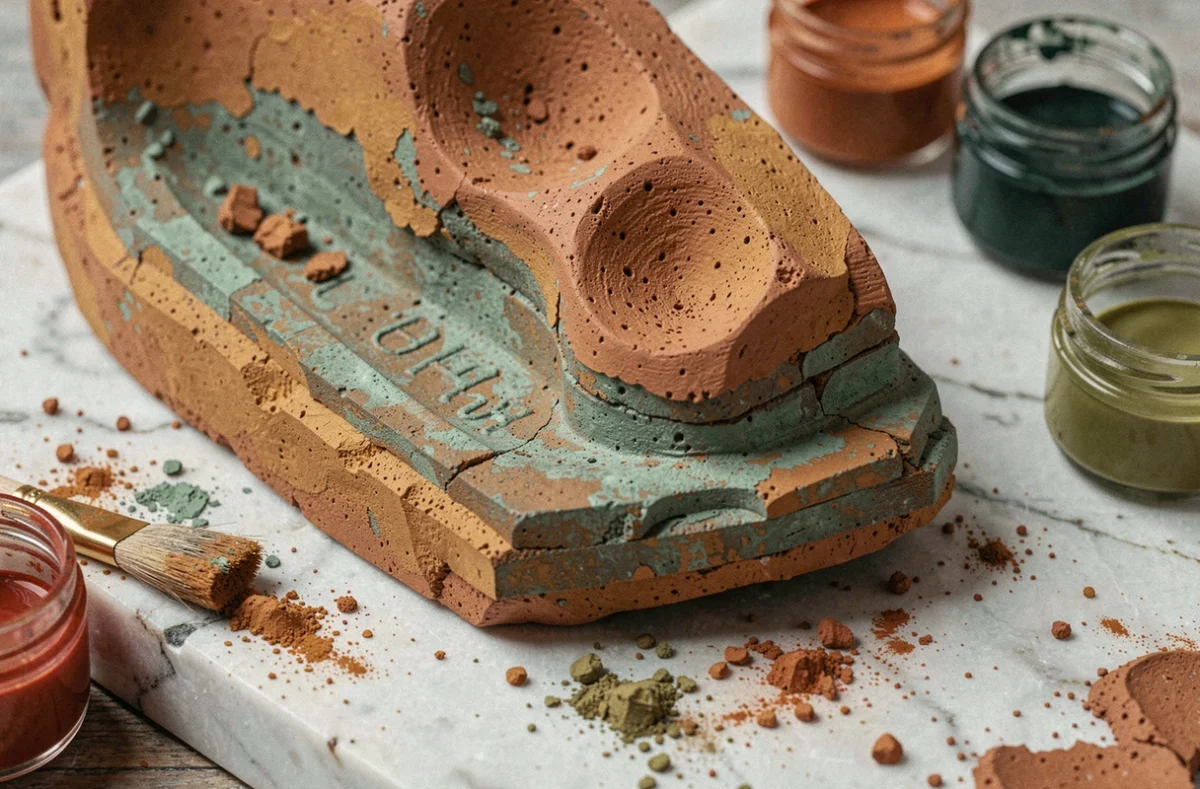
Terracotta remains a porous material after firing. This porosity determines how the binder and pigments penetrate the substrate. A highly porous piece absorbs patina unevenly, resulting in darker areas where the clay has absorbed more product.
Several sculptors apply a first very diluted layer (wash) to even out absorption. This undercoat reduces porosity discrepancies without completely clogging the pores. Terracotta thus retains its ability to breathe, which is important for the long-term stability of the piece.
Engobe before firing or cold patina: two distinct approaches
The engobe, a mixture of coloring oxides and white clay, is applied before drying and firing. The colorants partially vitrify in the kiln and become an integral part of the body. The engobe fixes the color within the mass, while cold patina remains on the surface.
Cold patina (wax, oil, or acrylic) is applied after firing. It overlays the substrate without chemically altering the clay. This distinction affects durability: a well-fired engobe resists abrasion much longer than a wax applied to the surface.
Natural pigments and synthetic pigments: differences in behavior on terracotta
Natural pigments (ochres, sienna earths, iron oxides) often have a coarser granulation than synthetic pigments. On a porous surface, this granulation grips in the hollows and textures of the modeling, enhancing the reliefs.
Synthetic pigments, being finer, produce more uniform flat areas. The choice between the two depends on the desired effect:
- Natural pigments for an aged, earthy look, with tonal variations in the hollows of the modeling
- Synthetic pigments for bright colors or shades that are difficult to achieve with natural clays (intense blues, greens)
- A mix of both to combine the depth of ochres with a more saturated color accent in certain areas
The pigment/binder ratio directly influences opacity. An excess of pigment compared to the binder weakens the layer, which may then powder upon touch. The ratio should be tested on a sample piece rather than on the sculpture itself.
Conservation of a patinated sculpture: stability of the environment rather than miracle varnish
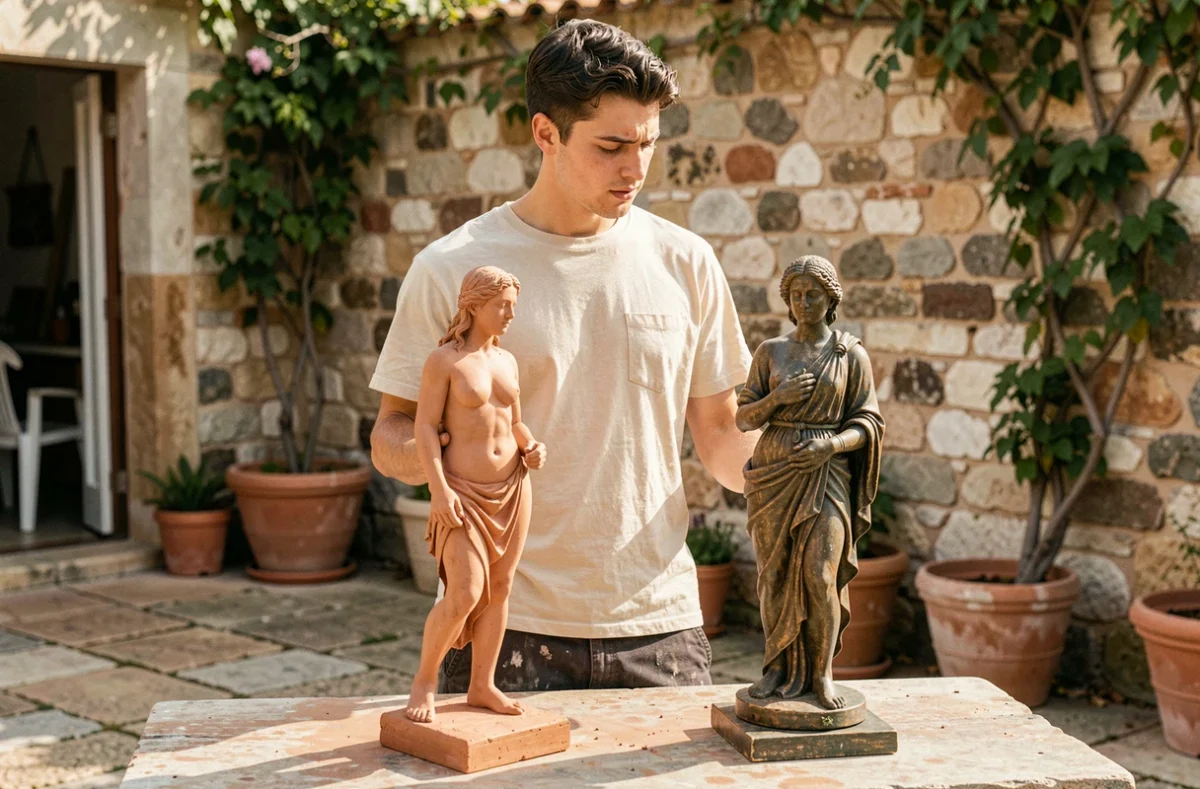
A wax patina does not waterproof terracotta. The piece remains sensitive to humidity variations, and prolonged exposure to water can cause stains or whitening of the wax. Maintaining a stable relative humidity between 40 and 60% limits the risks of degradation much more than an additional layer of varnish.
Rapid humidity fluctuations matter more than the absolute number. A piece placed near a radiator or a south-facing window undergoes expansion cycles that can crack the patina layer. Before choosing a location, it is advisable to observe temperature and humidity fluctuations over a few days.
Cleaning and regular maintenance
Dry cleaning (soft cloth, soft brush) remains the safest method for a patinated terracotta. Water can penetrate unevenly depending on porosity and leave visible rings once dry. For sculptures displayed outdoors, a hardening varnish compatible with the binder used can enhance protection, provided its reversibility is verified.
- Regularly dust with a soft-bristled brush to prevent particles from embedding in the wax
- Avoid liquid cleaning products or solvents on a wax patina, which would dissolve the binder
- Document the composition of the patina (type of binder, pigments used, number of layers) to facilitate any future restoration
Documenting the applied patina may seem secondary at the moment, but it becomes invaluable if the piece needs to be restored years later. A restorer who knows the original binder avoids layering an incompatible product, preserving both the appearance and structure of the sculpture.